
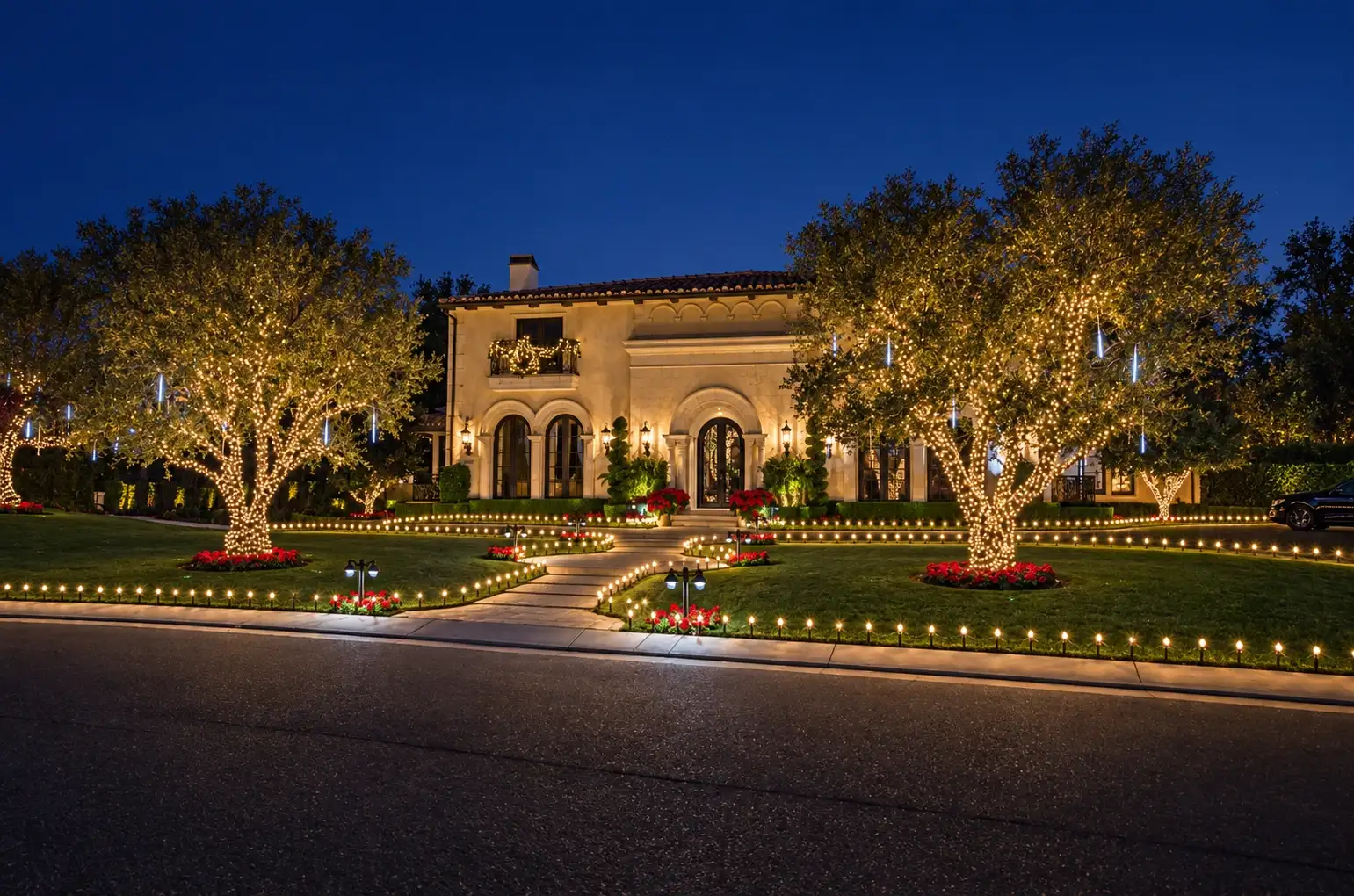
An HOA is not a homeowner, and the process is not the same
A homeowner can decide on a Saturday to light the house. An HOA cannot, because the entrance and common areas belong to the community, not to any one person, and spending on them has to go through whatever approval process the community already uses for its other shared expenses.
Treating a common-area display like a bigger version of a house display is where a lot of communities lose the good install dates and end up rushing a decision in November.
This post walks through how a board typically moves from “we should do something with the entrance” to a scheduled install, and it is the HOA-specific half of the broader process covered in planning holiday lighting for a business.
Get it on the budget cycle, not the agenda in November
The single biggest difference between a board that gets the install date it wants and one that does not is timing. Communities that budget for entrance and common-area holiday lighting the same way they budget for landscaping or a clubhouse repair, on a cycle set months ahead, have the display approved and scheduled before the season’s busiest weeks.
Boards that bring it up as a November agenda item are choosing from whatever install slots other properties have not already taken.
If your community does not currently treat holiday lighting as a line item, that is the first thing to change, not the display itself.
Decide what actually needs approval
Not every board runs the same way. Some communities have a single board vote; others route a proposal through an architectural or beautification committee first, then to the full board.
Either way, what gets put in front of whoever approves it matters more than who that person is: a written scope with what gets lit, what color, the install date and the takedown date, is something a board can vote on. A verbal description of “some lights on the entrance” is not, and it is how a display ends up half-approved and half-remembered.
What to light on shared property
Most communities do not need, or want to pay for, lighting on every common-area feature. The order that tends to matter for an entrance and shared spaces:
- The entrance monument and main approach. This is what every resident and visitor sees first, and it carries the most weight for how the whole community reads from the street.
- A guard house or clubhouse where the community has one, since it is usually the next most visible shared structure.
- Common-area trees near the entrance once the entrance itself is covered.
- Interior common areas only if there is budget and appetite left after the first three.
A common mistake is spreading a fixed budget across every tree and shared space in the community instead of concentrating it where residents and visitors actually see it first.
Decide maintenance and takedown before, not during
The question that causes the most friction mid-season is the one boards skip: who gets called when a section goes dark, and who takes it down in January.
A dark section on an entrance monument is the kind of thing residents notice and mention, and a board does not want that question landing on a volunteer with a ladder in the middle of December.
Most communities are better served deciding this upfront as part of the same agreement that covers the install: a single point of contact who handles the install, checks and repairs through the season, and takedown and storage once the season ends.
That keeps the responsibility with one agreement instead of falling on whichever board member happens to notice a problem first.
Telling residents what to expect
A board that has approved a scope and a schedule still has one more step: letting residents know what is happening and when. A short notice ahead of the install date, covering when the entrance and common areas will be lit, whether any parking or access near the entrance will be affected during install, and roughly when takedown happens in January, heads off a lot of the questions that otherwise land on individual board members.
It also gives residents a clear channel to report a problem, rather than each one separately noticing a dark section and wondering who to tell.
This does not need to be complicated. It is the same kind of notice a board already sends for landscaping work or a common-area repair, just applied to holiday lighting on the same schedule.
Where this fits with the rest of the community’s grounds
Entrance and common-area holiday lighting is one piece of what a board manages on the property, alongside landscaping, lighting for walkways and any other shared amenities. It does not need to be treated as a separate, one-off decision every year once it is on the budget cycle and the maintenance question is answered.
For the fuller planning process, including how power, timers and scheduling work for a shared property rather than a single home, see planning holiday lighting for a business. For a written scope specific to the area, see commercial holiday lighting in St. George.
Written by Michael Preston, Glow Forward Holiday Lighting. More from the blog