
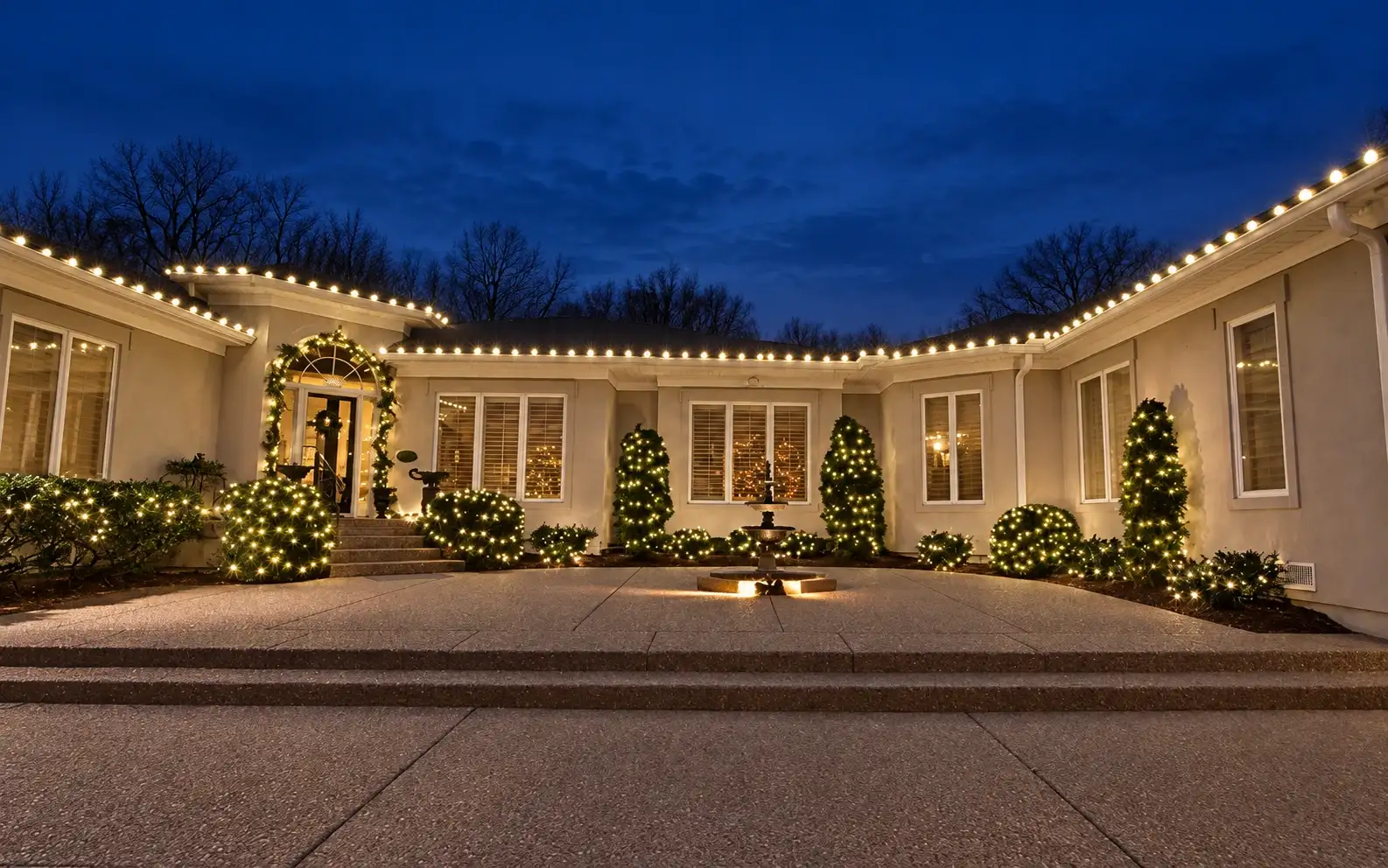
Why measuring first makes for a faster, more accurate quote
A rough set of measurements and a handful of photos, sent before anyone visits the property, turns a vague phone call into a specific quote. It does not replace an on-site look, but it means the person putting the quote together already knows the shape of the job instead of starting from a blank page.
This is the same information a Christmas light installation design walk covers in person; measuring ahead of time just moves part of that step earlier.
Start with the roofline
The roofline is almost always the largest part of the job, so start there. Walk each edge you want lit — the front eave, the sides, the back if it is visible from anywhere you care about — and measure the length of each section with a regular tape measure.
Add the sections together for a rough total. It does not need to be exact to the inch; a number that is close is far more useful than no number at all.
If the roofline has breaks, corners or level changes, note where they are rather than just the total length. A single 80-foot number reads very differently depending on whether it is one straight run or eight short sections joined at odd angles.
Eaves, peaks and gables
Beyond the main roofline, note any peaks or gables you specifically want outlined, since these often get lit separately from a straight eave run. A steep peak over a garage, or a gable end that faces the street, is worth calling out on its own rather than folding it into the general roofline total.
Windows and doorways
If you want a front door, a set of front-facing windows, or an entryway outlined, note which ones and roughly how large each opening is. This is a smaller measurement than the roofline but it is easy to forget to mention until someone is already on-site, which slows the process down.
Walkways, porch rails and low features
Anything at ground level — a walkway, a porch railing, a low fence — is worth a rough length the same way the roofline is. These features are usually a smaller part of the job but they are also the easiest to measure accurately yourself, since nothing requires a ladder.
Trees and shrubs
For any tree or shrub you want included, note roughly how tall it is and whether it is reachable from the ground or would need a ladder to reach the upper branches.
A rough trunk circumference is useful for a tree you want wrapped. It is fine to simply describe a shrub bed as “the row of shrubs along the front walk” rather than measuring each one individually.
A simple way to record what you find
You do not need a spreadsheet for this. A short list works fine: one line per roofline section with its approximate length, one line for each peak or gable you want called out separately, one line for windows or doors you want outlined, one line for walkways or railings, and one line per tree or shrub with a rough height.
Writing it down as you walk the property, rather than trying to remember it afterward, is the part that actually saves time later, since it is easy to forget a side of the house you rarely look at.
If more than one person in the household has an opinion on the design, it is worth doing this walk together, or at least comparing notes before sending anything in.
It is far easier to settle on what you want lit before a quote is built around it than to change the design once a plan is already in hand.
Take photos, not just numbers
Numbers alone leave out things a photo shows immediately: the roof’s pitch, how the house is laid out, whether there is a section that is harder to reach than the rest.
A few straight-on photos of the front of the house and each side you want lit, taken from far enough back to capture the whole roofline in one frame, do most of that work. A photo taken from an angle that shows the pitch of the roof is a useful addition. You do not need professional photos; a phone camera in daylight is enough.
What to do with your measurements
Once you have a rough roofline total, notes on any trees, windows or walkways you want included, and a few photos, you have what most quotes are built from.
What those specific measurements do to the price is a separate topic covered on Christmas Light Installation Cost; this page is only about getting the measurements themselves right before that conversation starts.
For how the rest of a professional install runs once the design is set — what gets hung, how it is attached, and how the season and takedown work — see How Professional Christmas Lighting Works.
Written by Michael Preston, Glow Forward Holiday Lighting. More from the blog