
The article
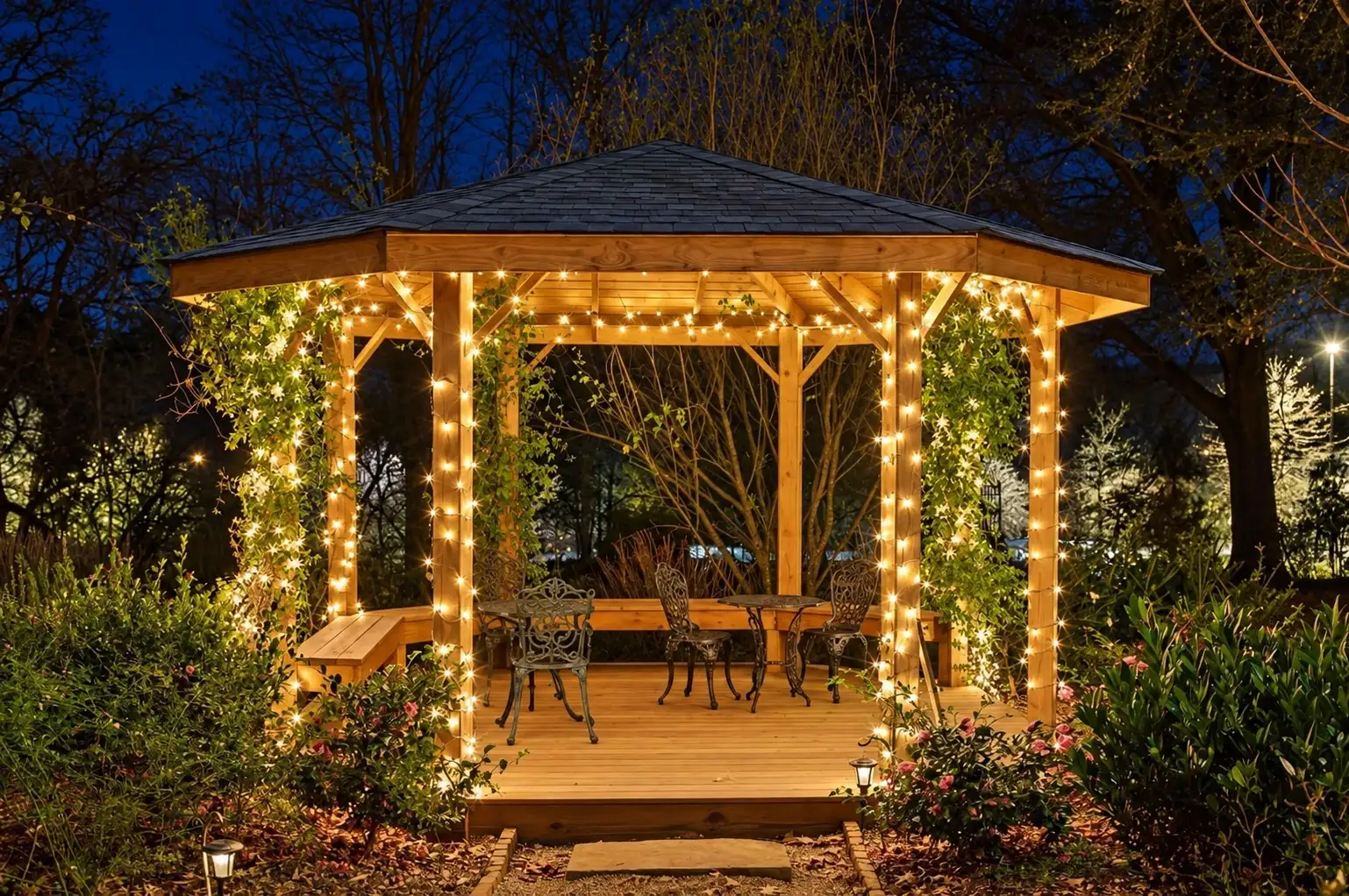
String lights are what turn a gazebo or pergola from a bare structure into a room people actually want to sit under after dark. The lights themselves are the easy part.
The layout, the spacing, and where the power comes from are what decide whether the finished look is even and intentional or uneven and obviously improvised.
This post is one piece of the plan covered in our year-round yard lighting guide. Here we’re focused specifically on the overhead string lighting over a covered structure.
Three common layouts
Zigzag. The string runs back and forth across the rafters or beams in a repeating pattern. This is the most common layout for a pergola with regular beam spacing, because it gives fairly even light across the whole area without needing as many total runs as a full canopy.
Perimeter. The string follows the outline of the structure rather than crossing the middle. This reads more as an outline of the gazebo or pergola itself than as overhead ambient light, and it’s a simpler install since every run follows the same edge.
Canopy. Multiple runs cross the overhead space in more directions, filling it more densely than a zigzag. This gives the fullest, most immersive look directly under the structure, at the cost of more total string and more mounting points.
None of the three is universally “correct.” A pergola with widely spaced beams and a table directly underneath often suits a zigzag or canopy, since the point is even light over where people sit.
A gazebo you mostly view from a distance, like across a yard from a patio, can look just as good with a perimeter run that outlines its shape.
Spacing matters more than the number of lights
However many bulbs a string comes with, spacing along the run is what the eye actually notices. Even gaps read as intentional; a run that ends with one bulb bunched up at the last few feet because the length didn’t divide evenly reads as an afterthought.
Plan spacing around the actual length of the beams or rafters you’re running the string along, and adjust the layout, not just the bulb count, if a run comes up short.
Sag is the other detail worth planning for. A little natural sag between mounting points looks intentional and relaxed; too much sag on a long run without enough support points looks like the string is about to come down. Support runs longer than a few feet at more than just the two end points.
Where the power comes from
This is the detail that’s easiest to skip and the hardest to fix afterward. String lights need power run to the structure from an existing exterior outlet, and because a gazebo is often the farthest structure from the house, that run needs to be planned before you buy a single string, not worked out once the lights are already hung.
Decide where the feed comes in before you finalize the layout; it will often decide which end of the structure the runs should start from.
Leaving them up all year
A seasonal string light plugged into an extension cord and unplugged when the weather turns isn’t built for a permanent install. A run meant to stay up year-round uses weather-rated fixtures and cable, and treats the whole thing as part of the property’s low-voltage lighting system rather than a temporary decoration.
That’s the difference between taking string lights down every fall and having a gazebo or pergola that just looks finished, every night, all year.
Pairing string lights with a second layer
String lighting overhead looks best when it isn’t the only light on the structure. A low downlight at the base of each post, or a small accent light on any bench or step under the gazebo, gives people a way to see where they’re sitting and walking without needing the overhead string to be bright enough to do both jobs.
It also keeps the string lighting itself dimmer and more ambient, which reads better after dark than an overhead layer turned up to compensate for a dark floor.
Keeping color temperature consistent
Whatever warm or cool white you choose for the string lights, matching it to the rest of the property’s lighting matters more under a gazebo or pergola than almost anywhere else in the yard, since it’s usually the one structure people sit under and look up into directly.
A cool-white string over a warm-lit patio reads as mismatched the moment someone walks from one to the other. Settle on a single color temperature for the whole yard before ordering string lights for just the one structure.
Where this fits with the rest of the yard
Gazebo and pergola lighting is one piece of a larger yard lighting plan alongside path lighting, tree uplighting and pool-area lighting.
If you’re planning the whole property rather than just the one structure, our landscape, pool and gazebo lighting page covers how the pieces fit together, including how a gazebo or pergola install is scheduled alongside the rest of the yard.
Written by Michael Preston, Glow Forward Holiday Lighting. More from the blog