
The article
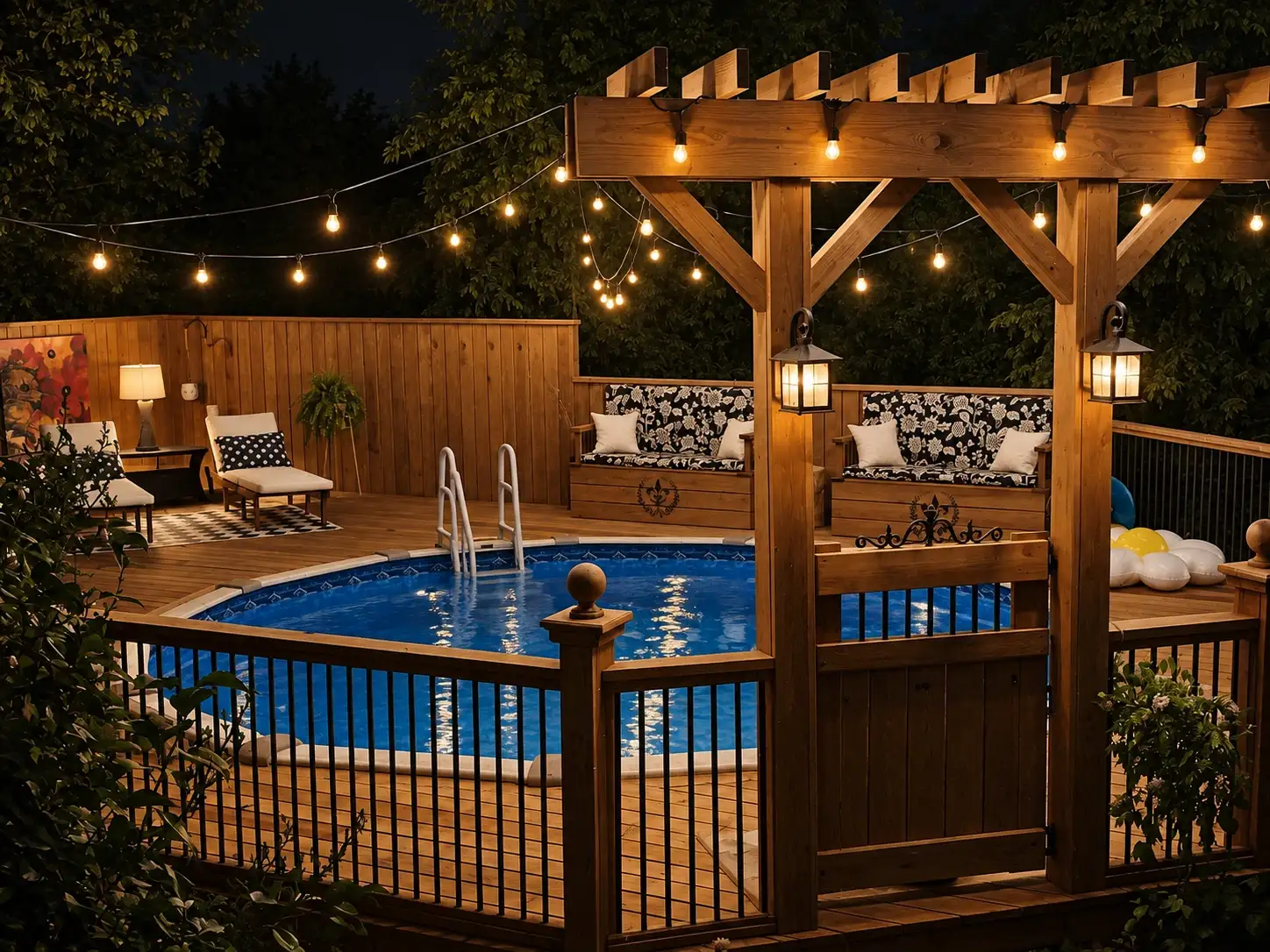
A pool deck at night is a different lighting problem than the rest of the yard. It has two things working against it that a patio or a lawn doesn’t: a wet, slick surface right next to a level change into open water, and a flat, reflective surface that will throw a badly aimed light straight back at anyone standing nearby.
Get those two things right and the pool area becomes the best-looking part of the yard after dark. Get them wrong and you end up with a glare-y deck that people avoid using once the sun goes down.
This is one piece of the larger plan covered in our year-round yard lighting guide, which walks through paths, uplighting, patios and gazebos as well. Here we’re focused specifically on what to light immediately around the water.
Light the edge first
The single most important line to light around any pool is the edge of the water: the coping, and any steps down into the pool. That’s the level change someone is most likely to misjudge in the dark, particularly a guest who hasn’t swum there before and doesn’t know exactly where the deck ends and the water begins.
Low, downward-aimed fixtures set back slightly from the coping do this job without putting a bright point of light right at the waterline.
Light the whole deck, not just the pool itself
Beyond the coping, the full deck surface benefits from the same path-and-step logic as the rest of the yard: enough light that a wet foot on a hard surface is visible, especially at any stair, ledge or change in deck material.
A pool deck that’s dark six feet back from the water is still a hazard, even if the water’s edge itself is well lit.
Keep glare off the water
This is the mistake that separates a good pool lighting plan from an amateur one. Any fixture aimed even slightly toward the pool surface, or mounted at a height close to eye level near the deck, will bounce light back at anyone standing or sitting nearby.
Because the water is flat and still most of the time, that reflection is far more noticeable than the same glare would be over grass or stone. The fix is aiming every fixture near the pool down and away from the water, and choosing fixtures with a shield or a recessed lens rather than an exposed bulb wherever someone might be standing close to one.
Fixtures built for a wet location
Anything installed at or near the deck and coping needs to be rated for a wet location, not just an outdoor-rated fixture meant for a dry flower bed a few feet away.
Splash, pool chemicals and standing moisture are a harsher environment than the rest of a typical yard, and it shows up first at the cable connections and fixture seals if the gear wasn’t built for it. Fixtures set further back in the surrounding landscaping, away from splash range, can generally match the low-voltage system running through the rest of the yard.
Matching the pool area to the rest of the yard
Pool lighting doesn’t have to look like a separate system bolted onto the yard. Using the same color temperature around the deck as everywhere else, and treating the pool-area fixtures as one more layer in the same low-voltage run as the path and accent lighting, keeps the whole property looking like one plan instead of a patchwork of projects added at different times.
The wet-location fixtures right at the coping can still match the warm white of the path lights ten feet away; only the housing needs to be different, not the look.
A few mistakes worth avoiding
The most common mistake around a pool is over-lighting the water itself and under-lighting everything else. A bright light aimed at the pool draws the eye, but if the deck around it is dark, people still can’t see the edge they’re walking toward.
The second common mistake is mounting a fixture directly at a height where someone standing at the pool’s edge looks straight into it; even a well-shielded fixture can cause glare if it’s aimed at head height instead of down at the deck or coping.
What this project does and doesn’t cover
A pool-area lighting project like this one covers the deck, the coping edge, the steps and the landscaping immediately around the pool. It is not the same scope as in-water pool lighting, which is a separate system tied to the pool’s own equipment.
If you’re planning a project that includes both the deck lighting described here and the rest of your yard, our landscape, pool and gazebo lighting page covers where pool-area lighting fits alongside path lighting, tree uplighting and patio or gazebo string lighting.
Getting it right the first time
The best way to plan a pool-area lighting layout is a walk of the deck after dark with the pool lights (if any) on and off, so you can see exactly where glare shows up and where the deck actually goes dark.
That’s the same walkthrough a design visit uses, and it tells you far more than a daytime look at the same space ever will.
Written by Michael Preston, Glow Forward Holiday Lighting. More from the blog